4 minute read · Practical field guide
Start with the final submitted message
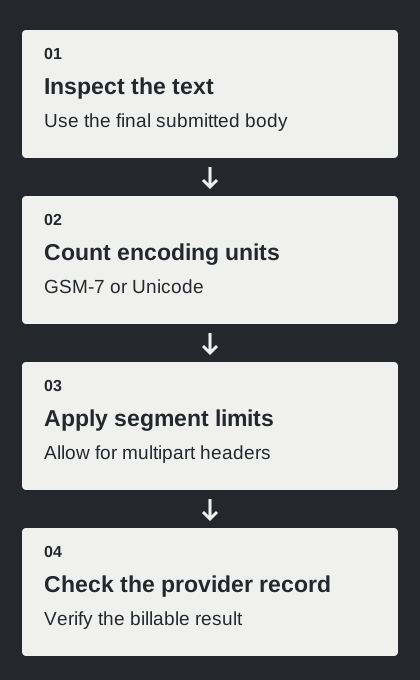
SMS segmentation divides a long submitted text into transport parts, even when the phone presents one message. A draft in a campaign editor may differ from the body sent to the messaging provider. Your application might append a business name, insert a customer reference or replace a short placeholder with a long URL. Some providers also offer transformations such as smart encoding. Make the exact submitted text the starting point for a cost investigation, and record which transformations are enabled.
For a planning exercise, gather a small set of realistic examples: a short pickup notice, a scheduling question, a longer explanation and a message containing the punctuation your staff normally use. Do not estimate an entire workflow from the shortest possible sample. Incoming replies may also be billable under your commercial arrangement. Keep the quote’s billing definitions beside the examples so the units in the estimate match the units on the invoice.
Distinguish characters from encoding units
Twilio documents a single-segment limit of 160 GSM-7 units or 70 Unicode units. Multipart limits are typically 153 and 67; its US/Canada toll-free exception uses 152 and 66. GSM extension symbols take two septets, while Unicode characters outside the basic multilingual plane, including many emoji, use a UTF-16 surrogate pair. The tool below counts these units rather than only the visible symbols.
This matters when editing. A change that looks small can alter the encoding of the whole body. Curly quotation marks, for example, are outside the GSM-7 alphabet. Replacing punctuation may affect the estimate, but meaningful names and languages should not be removed merely to force a cheaper encoding. Treat readability and correct customer information as requirements, then budget for the message that actually needs to be sent.
Work through the boundary instead of guessing
Consider an intentionally simplified GSM-7 example made entirely of the letter A. At 160 letters, the draft fits one standard segment. At 161, multipart overhead applies and the message needs two parts. Dividing the text length by 160 would produce the wrong threshold for the concatenated message. The calculator switches limits when the single-segment capacity is exceeded.
Now replace the sample with a real template and add the business name and final link. Watch the encoding and segment result together. If the result changes, inspect the actual difference before editing. The estimator keeps extended GSM pairs and Unicode surrogate pairs together at boundaries; provider handling can differ. This is a diagnostic aid, not a promise about the charge for a specific carrier route or provider configuration.
Turn a segment count into a transparent estimate
The basic arithmetic is billable segments multiplied by the applicable per-segment rate, with other charges added separately. For a fictional example, 2,000 billable segments at a combined rate of $0.015 produce $30 of usage. Those numbers are invented to demonstrate the calculation; they are not a quote from any provider. Software, numbers, registration, media and other fees may use different units.
Estimate a range when the workflow contains variable-length replies or personalized content. Keep inbound and outbound usage separate if their rates differ. If your provider charges differently by destination, number type or message category, calculate those groups independently. A single blended rate can be useful for a rough budget, but it should not hide the assumptions needed to reconcile an actual bill.
Reconcile an unexpected bill with message records
Choose a few representative message identifiers and compare the submitted body, reported encoding or segment count where available, destination, route and billable status. Look for systematic causes: appended text, longer personalized values, duplicate submissions or a pricing assumption that excluded a charge. Avoid drawing conclusions from a screenshot of the customer’s phone, which may show a reassembled conversation without the relevant billing detail.
If the provider record and your calculation differ, preserve the example and ask the provider to explain its treatment. Do not silently change accounting data to make an estimate agree. The goal is an understandable explanation that can be applied to the next month’s forecast. Keep any customer content used in the investigation within the systems and access controls your business has approved.
For Messaging Services, Twilio may initially report zero segments before sender assignment; pricing can arrive later. Reconcile the finalized record, currency and applicable fees.
Use the checker with its limits in mind
Paste or type a draft below and choose the standard or US/Canada toll-free multipart limit. The tool updates the estimated segment count and encoding locally. It accepts up to 10,000 UTF-16 code units for exploration, but that is an input limit of this tool, not a supported sending limit for a provider. Nothing is transmitted as a text message.
Check the final provider payload and billing record before treating the result as a cost fact. Smart encoding, appended content, route rules and provider-specific restrictions can change the outcome. The checker is for SMS; it does not estimate iMessage, MMS or RCS billing. Use it to ask better questions about templates and quotes, then keep the confirmed commercial assumptions in your buying worksheet.
This estimator omits national-language shift tables and smart-encoding transformations; its UTF-16 counting does not guarantee provider acceptance.