4 minute read · Practical field guide
Name the information your application needs
A service may need incoming customer messages, outgoing delivery updates or the current state of an uncertain send. Those are different data needs. A webhook can notify your application about an event; a retrieval request can ask the provider for an available record. Before choosing a pattern, list the events and state your business workflow requires.
Check the provider’s actual API and event documentation. Twilio documents incoming-message requests and a Message resource; Telnyx documents messaging events and webhook handling. The presence of one mechanism does not establish every recovery capability you may want. Find out which records can be retrieved, which identifiers connect them and what access or retention conditions apply.
Compare the responsibilities, not just the trigger
Webhooks shift event delivery toward the provider, while polling schedules retrieval from your application. Both need authentication, error handling and a durable record of what was processed. A successful HTTP exchange is only one part of the business workflow. The customer’s request may still need a separate record update or human action.
The table identifies implementation questions to answer for your selected service. It is an architectural comparison, not a claim that every API provides the same endpoints or event guarantees.
| Question | Webhook approach | Polling approach |
|---|---|---|
| When does work begin? | On receipt of a supported event | On your retrieval schedule |
| What can repeat? | A provider retry or replayed event | The same record in later retrievals |
| What must be stored? | Event identity and processing outcome | Retrieval progress and processed record identity |
| How is a gap investigated? | Compare received events with available records | Check pagination, time windows and retrieval failures |
Make webhook receipt durable before business work
Follow the provider’s verification procedure and validate the request before trusting it. Preserve the event durably so a later worker can apply the business operation. Keep receipt, acknowledgement and processing outcomes distinguishable. Heavy work inside the request handler can complicate retries and make it harder to understand whether an event was accepted or fully acted upon.
Design repeated delivery to leave the business action unchanged after successful processing. The appropriate event identifier and handling rules come from the provider’s documentation. A message identifier and an event identifier may describe different things, so inspect the payload rather than choosing whichever field looks unique. Keep a recovery path for events stored successfully but not yet processed.
Give retrieval an explicit progress model
If you poll, define what range or cursor is being read, how pages are followed and when progress is committed. Records may change between requests, and a time-based window can create edge cases at its boundaries. Follow the API’s documented pagination behavior and keep enough overlap or reconciliation logic to avoid losing a record solely because a checkpoint moved too early.
A repeated record should be safe to inspect again. Compare the provider state with the application’s current state before applying a transition. Back off appropriately when requests fail or limits are reached, and expose retrieval gaps to operators. Increasing the polling frequency cannot compensate for an incorrect checkpoint or a business operation that repeats on every read.
Reconcile after a gap in processing
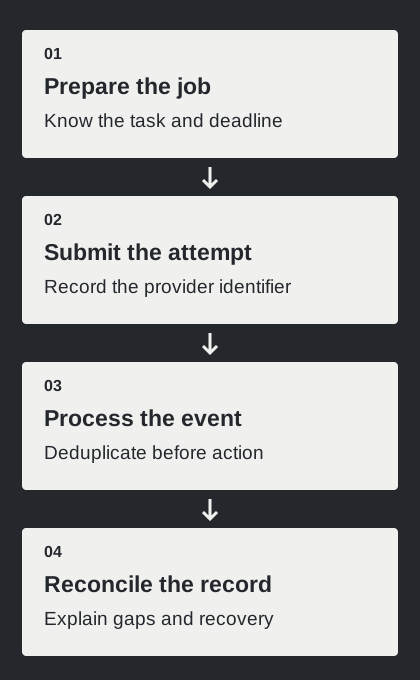
Imagine the receiving service was unavailable during a deployment. First establish which events were received, which were processed and which provider records can be inspected. Use the provider’s retry and retrieval features within their documented scope. Do not assume an unlimited event history or a replay endpoint exists because another service offers one.
Reconcile by durable identifiers and current business state. A delayed event may describe a task already resolved by a colleague. Preserve the transport evidence while deciding whether any business action remains necessary. This allows the application to recover history without sending stale messages or applying a customer change twice. Record unresolved gaps explicitly when the available evidence cannot settle them.
Test a combined design against ordinary failures
Use an isolated test setup to repeat an event, delay a status update, interrupt a retrieval page and restart a worker after partial processing. Verify the final business record and the operator-visible explanation. The design should show why a repeated event was skipped or why an unresolved record still needs investigation.
Choose the combination that meets your workflow with manageable complexity. Some applications can rely primarily on supported webhooks with occasional reconciliation; others require scheduled retrieval for specific records. Keep the distinction between live notification and recovery evidence in the design notes. That makes the system easier to maintain when provider behavior, traffic or operational requirements change.