4 minute read · Practical field guide
Begin with a task, not a list of features
Take a routine B2B appointment confirmation. The customer needs to know which company is writing, what time is proposed and how to answer. They do not need to see your automation builder or understand how the message was sent.
That is a useful reason to start with SMS: a short, familiar exchange can be enough. Choose a task your team already performs, write the smallest useful message and decide who will handle the reply. A complicated feature list is unnecessary until the task calls for it.
There are three separate things to choose
First is the messaging channel. Second is the interface your staff uses to read and answer conversations. Third is any connection to your CRM, booking system or application. A product may supply several of these together, or your business may assemble them.
An API gives software a way to request an action; it does not automatically give staff a finished inbox. A team without an engineering owner may prefer a business texting service with the daily working interface already provided. Inspect the actual plan rather than relying on the category name.
Choose iMessage when its features help the job
A business iMessage service can be relevant when your customers use a compatible setup and the workflow benefits from supported richer messaging. Confirm the provider’s business features separately from what the consumer messaging app can do.
For a plain confirmation, SMS may already meet the need. For a media-rich conversation, compare the supported iMessage, RCS or MMS options. A different bubble color is not, on its own, an operating requirement. Let the task and the recipient determine what matters.
Ask for one understandable quote and one complete demo
Describe the number of staff, expected conversations, typical message lengths and any attachments. Ask the provider to explain the resulting charges, setup requirements and limits. A low unit price is useful only when you know the units your workflow will use.
Then watch a message go out, a reply come back and a colleague complete the task. If the team can explain that path and the bill, you have a manageable starting point. Add more connections after the basic exchange is dependable and someone owns its ongoing operation.
Trace one message from the business event
A fictional wholesaler marks an order ready, prepares a pickup message and submits it through a messaging service. The service may return an identifier before the phone receives anything. Later events can describe sending or delivery, and a customer reply arrives separately. Keep these stages distinct when explaining the system to the team: the order event, send request, transport outcome and business answer are different records.
This distinction is useful even if you never write code. Ask the vendor where staff can see an unsuccessful send, where an incoming answer appears and how an unresolved request reaches a colleague. The simplest product is the one your team can operate correctly, including exceptions. An easy outgoing button is only one part of an easy customer conversation.
Understand why a short draft can cost more than one unit
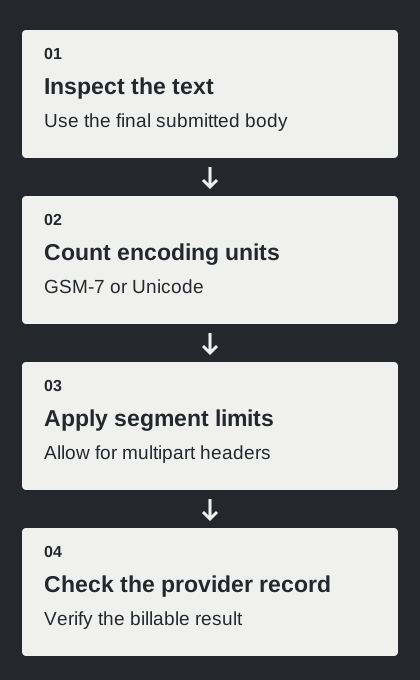
SMS is billed in segments by providers such as Twilio. The text’s encoding and length determine how it is split. Ordinary GSM-7 text has different limits from Unicode text, and some symbols count as more than one encoding unit. The phone may display a reassembled message as a single bubble even when more than one segment was transmitted.
Use realistic templates when estimating usage: actual punctuation, sender name, links and any required footer. A placeholder such as “[link]” can understate the length of the final URL. Review an example of the exact submitted body and compare it with the provider’s reported usage. Our segment guide includes a calculator for exploring these differences, with clear limits on what an estimate can establish.
Put reply handling in the buying requirements
Before comparing API prices or inbox plans, describe the reply path. A recipient may answer a reminder with a changed date, a complaint or a question about a different order. Decide whether a person, an automation or a combination should handle that answer. The receiving system needs enough context to identify the customer’s task and avoid applying a reply to the wrong record.
Ask vendors to demonstrate the requirements in your intended plan and channel. Relevant questions include staff access, conversation assignment, inbound events, history export and error visibility. Do not assume every service described as “business SMS” includes the same team interface. A programmable transport API and a hosted shared inbox can serve different buyers even when both support sending texts.
Keep the pilot’s conclusions proportionate
A few successful messages can establish that a configured path worked in those cases. They cannot establish universal delivery, complete carrier coverage or a guaranteed business result. Record the devices, channels, message types and outcomes you actually observed. Add a changed request and a failed or unresolved case to the acceptance checks so the team learns how to recover.
When comparing options, separate documented features, quoted commercial terms and observations from your own pilot. If a required behavior remains untested, keep it listed as an open question. That is more useful than turning a provider’s broad marketing statement into a definitive score. A good selection record explains both why a service fits and which assumptions still need to be proven before expanding.