4 minute read · Brand comparison
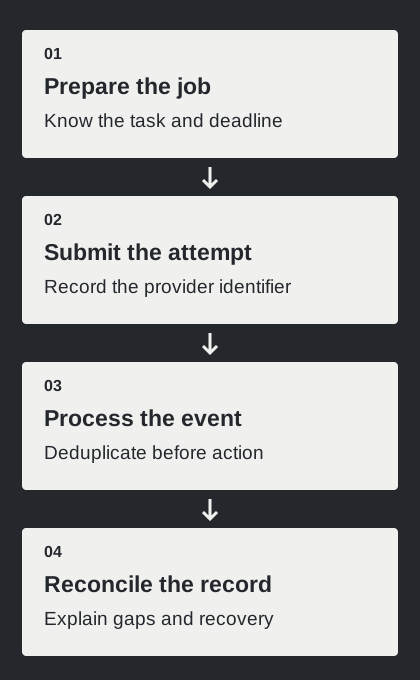
A successful send is a small part of the purchase
Sendblue and Linq both market developer access to messaging, but the first request in a quickstart is not the full integration. A production application must handle replies, identify the sender, recover from missing events and explain the difference between an accepted request and an observed delivery signal. That is the level at which the two candidates should be compared.
The public materials were checked September 28, 2026. Sendblue provides a visible inbound-first price and explicit sandbox restrictions. Linq-only update, November 10: published plans now replace the quote-only finding. Unknown details stay unknown here; they are not filled with a competitor’s estimate or an assumed enterprise entitlement.
| Decision | Sendblue | Linq |
|---|---|---|
| Published production anchor | AI Agent: $100 per line/month, inbound-first | Pro from $260/month; Enterprise custom |
| Initiating conversations | Full outbound is listed under Enterprise | Confirm permitted direction and account terms |
| Evaluation detail | 10 verified sandbox contacts; no webhooks | Sandbox promoted; confirm recipient and event scope |
| Channel question | Confirm production behavior for iMessage, SMS and RCS | Select the applicable product and channel contract |
| Service evidence | Obtain the agreement for the selected plan | Obtain the agreement for the selected plan |
Sendblue: plan direction and sandbox scope are explicit
The Sendblue AI Agent plan is a useful starting point for incoming customer conversations, with production webhooks and callbacks listed. Full outbound belongs to its custom Enterprise offer. That distinction should appear in the engineering brief: a team building proactive requested reminders is evaluating a different commercial configuration from an assistant that responds after someone texts first.
The sandbox’s lack of webhooks is also consequential. You can use it to explore supported requests, but a receiver implementation cannot be accepted against events the environment does not emit. Ask for an evaluation path that exposes the required production behavior. Keep the sandbox test record and production event test record separate so a passed quickstart does not become a misleading launch sign-off.
Linq: scope the messaging product and quote together
Linq advertises native iMessage, RCS, SMS and voice, while its documentation entry point presents distinct channel areas. Identify the specific API and onboarding path your application will use. If the discussion includes an Apple business-messaging product as well as iMessage, ask the supplier to explain the identity, initiation and approval requirements of each rather than treating the names as synonyms.
A quote should state the line or sender arrangement, the expected workload, support access and any contractual service commitment. Match that proposal to the documentation used by the development team. A tailored agreement may be a good fit, but it should not leave the buyer guessing whether the demonstrated feature belongs to the purchased service or to another part of the platform.
Use a small contract matrix
For both providers, request examples of incoming messages, outgoing status changes and failures. Record the stable identifiers, authentication method, retry policy and any ordering guarantees actually documented. Mark a field as unspecified when the source does not define it. An engineer can build around a known limitation; an undocumented assumption is harder to spot until the application depends on it.
Add sender lifecycle to the matrix. What happens during number activation, suspension, reassignment or recovery? Which changes are visible through the API, and who must handle them? Your customer record should not accidentally attach a reply to the wrong sending identity. This is a requirement to investigate in both products, not a claim that either currently has that failure.
Test recovery without involving real customer traffic
Run the first failure exercises with controlled recipients and non-sensitive content. Include a delayed receiver response, a repeated event and a request whose outcome is uncertain to the client. Describe the expected record before running each case. The application should retain enough evidence to reconcile the attempt without blindly creating another customer-facing action.
Then verify an ordinary round trip from your intended CRM or agent workflow. Ask another developer to explain the recorded result using only the logs and documentation. If the result depends on remembering what appeared briefly in a dashboard, improve the evidence trail. A repeatable test is more useful for maintenance than a one-off screenshot proving that one message arrived.
What should determine the final selection?
Choose to evaluate Sendblue when its explicit inbound-first path matches the application and you can obtain the production event access needed for acceptance. Evaluate Linq when its channel offering and scoped integration arrangement fit the project. For outbound work, compare the actual approved quotes from both; the visible entry price is not a reliable proxy for a different production workload.
End with a written contract matrix, the tested configuration and a named incident owner. Compare the development effort and operating responsibilities alongside the subscription. We do not assign a universal winner because the reviewed material does not establish independent performance results. The useful winner is the configuration that meets your documented requirements and can be supported by your team after launch.